Follow Me on Twitter

Nutella Bread for Dessert or for Breakfast!


Search this Site

Ravioli With a Rolling Pin!

Cream Puffs with Chocolate Sauce

Learn How to Make Parmesan Crisps - we love them as an appetizer


Butternut Squash Risotto


Learn How to Make Fresh Pasta

Not Your Usual Lasagna - No Meat and No Tomato Sauce!

SUBSCRIBE for free and never miss a post:


Or enter your email address:

Looking for Something? Search the Recipe Index


"If it doesn't rot, it's not real food."

-Joel Salatin,
Polyface Farms 

Sicilian Arancine

Learn How to Make Artisan Bread with no Kneading


 Thanks, Mom!


Strawberry Cheesecake Parfaits Require No Baking


My Favorite Dish - Spaghetti with Roasted Tomatoes and Pancetta

Food Photography

Chocolate Panna Cotta


Make Your Own Vanilla Extract

What's the Best Flour to Use for Pizza?

Entries in pesto (3)

Friday
Jul232010

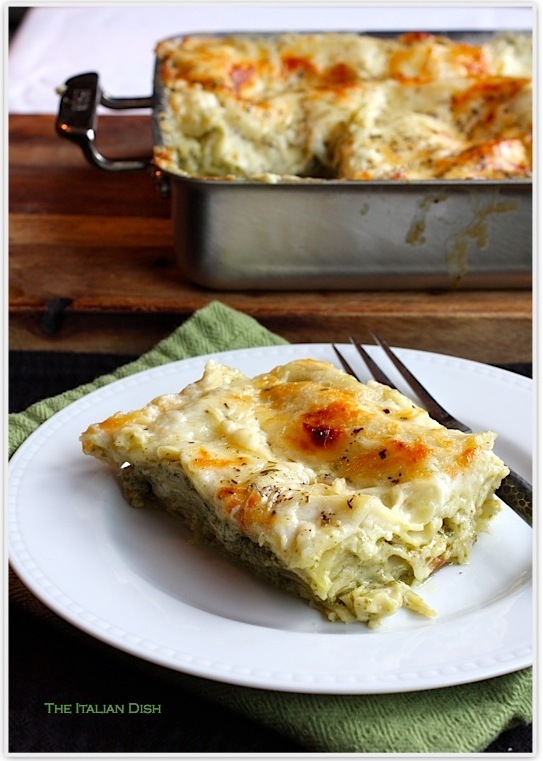
Pesto Lasagna


This is a great lasagna for summer.  It contains no meat and there is no tomato sauce.  It makes use of that great summer basil and it can either be a side dish to grilled meats or a main dish. 

If you want to save some cooking time, you can use no-boil lasagna noodles. Keep in mind, though, that these noodles require a lot of liquid or sauce in order for them to cook properly.  They absorb a lot.  So if you use these instead of regular cooked lasagna noodles, you have to make sure each layer is covered in plenty of sauce.   
Another tip for you when making lasagna is to use the No-Stick aluminum foil.  I can't believe how many people do not know about this product.  Reynolds makes a non-stick foil that is my everyday foil.  Foods don't stick to it and it's perfect for lasagna - you take it off the top and the cheese doesn't stick to it.  Once you use it, you'll never buy anything else.

Pesto Lasagna

for a printable recipe, click here

makes an 8x8 pan
4-8 servings

* note:  for this recipe in an 8x8 pan, you can make a smaller size lasagna using only 10 noodles (5 layers with only 2 sheets per layer).  You can also make a larger lasagna in this pan, using all the space by having 4 noodles per layer.

note on lasagna noodles: I find that regular lasagna noodles work best with this recipe.  That is, lasagna noodles that you cook first. Fresh sheets of pasta, cooked,  also work as well.  If you are using lasagna noodles which you have cooked, you don't have to use quite as much bechamel sauce.  If you are using the "no-boil" lasagna noodles, the noodles must be coated heavily with sauce, so that they cook properly.  They tend to absorb a lot of sauce.   I don't like them as well, but they will work alright if you want to save some time.  Just be sure to wrap the lasagna tightly with foil while cooking.

pasta:

* 10 - 20 no-cook lasagna noodles or fresh pasta sheets, cooked or regular lasagna noodles, cooked

pesto:

3 ounces Parmigiano Reggiano, cut into chunks
1-1/2 cups packed fresh basil leaves
1 garlic clove
1/4 cup pine nuts
1/2 cup olive oil

bechamel:

1/4 cup butter
1/4 cup flour
2 cups milk (whole or lowfat)
1 chicken bouillon cube (half, if using Knorr)
1 teaspoon grated nutmeg
1/4 teaspoon ground white pepper 

1 cup grated Parmesan cheese
3/4 cup grated mozzarella cheese
1 teaspoon dried oregano

Make the pesto:

Place the chunks of Parmigiano cheese into the food processor and process until finely ground.  Add the basil, garlic and pine nuts to food processor.  Process, using pulses, till finely chopped.  With machine running, add the olive oil until pesto is smooth.

Make the bechamel:

In a heavy medium saucepan, melt the butter.  Whisk in the flour and stir for a couple of minutes, until the flour is cooked.  Add the bouillon cube and allow to dissolve.  Whisk. Add about a third of the milk, slowly, and whisk over medium heat.  Add the nutmeg and pepper.  When the sauce is smooth, add another third of the milk and whisk.  When the sauce is smooth again, add the rest of the milk and whisk until smooth. Transfer to a heat proof bowl or Pyrex cup and let cool slightly.

Assemble lasagna:

Preheat oven to 350 degrees F.

In an 8x8 pan, place about 1/3 cup of the bechamel to coat the bottom of the pan. Lay first layer of lasagna noodles.  Add enough bechamel to coat the noodles.  Add some pesto and spread into the bechamel.  Add a handful of the grated Parmesan. Continue to layer the noodles, bechamel, pesto and Parmesan until the last layer of noodles.  On top of this, just spread the bechamel only, add the rest of the Parmesan and top with the mozzarella.  Sprinkle the oregano on top.  Wrap tightly with foil (preferably Reynolds No-Stick foil).

Bake for one hour (if using regular, cooked noodles) or one hour and 15 minutes (if using no-boil noodles). Remove foil and bake for 10 minutes more, until top is golden.  Remove from oven and allow to sit for 15 minutes before slicing.


Lots more lasagna recipes:

Lasagna with Red Pepper Tomato Sauce  

Individual Lasagna Gratins

Roasted Vegetable Lasagna

My Mom's Zucchini Lasagna


Spinach Lasagna with Bolognese Sauce

Thursday
Oct012009

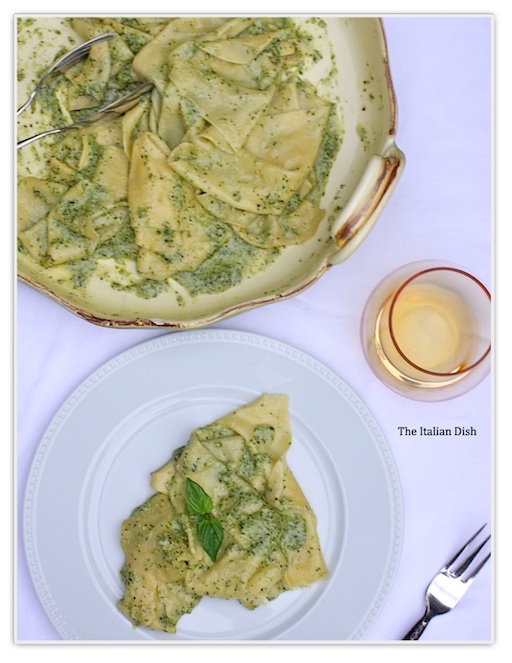
The Perfect Pesto with Pasta Squares

We've all made our share of pesto in the food processor and it's quick and delicious.  But when you watch this charming video of Chef Paolo Laboa of Farina, you will be tempted to try his authentic Genovese method of making pesto with "il cuore" - the heart.  When I heard Marcia Gagliardi of Tablehopper describe this dish of pasta in the video, I knew I had to try it - when Marcia raves about a dish, you know it has to be outstanding. But first I needed the real, authentic ingredients that Chef Laboa describes in the video.  This was no easy task.
 

First was the issue of the pine nuts.   Chef Laboa says that you need the real Italian pine nuts.  Well, aren't those pine nuts in the grocery store the same?  It turns out, they are not.  Almost all of the pine nuts that any of us have ever purchased are from China.  That's right.  The real pine nuts from the Mediterranean are much harder to find.  It took me a while but I did find an online source that had them, NutsonLine.  When I saw the price, however, for the real thing I understood why all those pine nuts in the grocery store are from China. I wanted to make this pesto, though, with all the ingredients that Farina uses, so I bought them.  Once.

Then came the olive oil.  Chef Laboa says that you need to use a light, Ligurian olive oil, not extra virgin olive oil because it "kills the flavor" of the basil.  After looking very, very carefully at the video and freeze framing, I was able to identify the olive oil he used.  It was Opera Prima from Liguria.  It was not as easy to actually find the oil, though.  There was only one source I found that had it - ChefShop.com.  

The basil was easy.  My farmer's market has a lot of beautiful basil and I also grow some myself.  So, armed with all the ingredients that Chef Laboa recommended and a great mortar and pestle, I made this pesto. 

 I ground the pine nuts and coarse salt together first and then slowly added the basil.  It definitely is a process to do it this way - a labor of love.  Then I slowly added the olive oil and finally, the parmesan cheese.  I could not get my pesto to become as creamy as Farina's, but maybe I did not grind it long enough.  I thought I had ground it about as long as I could, though!  But I will say that, without a doubt, this was the best pesto I've ever had.  The flavor was unlike any other pesto I've ever made.  It was worth it.   

One interesting note about the homemade pasta that Chef Laboa makes is that it contains a little white wine - something specific to Genoa.  I made my pasta this way, also.  The pasta is rolled into sheets and then simply cut into squares.

I give a recipe here, but it is only an estimate - the recipe is really about technique. You can adjust it the way you like it .   

Pasta Squares With the Perfect Pesto

for a printable recipe click here

1/2 cup Mediterranean pine nuts
1 teaspoon coarse salt
1 small clove garlic
1 cup packed fresh basil leaves, soaked in water and dried
1/4 cup or more light Ligurian olive oil
1/4 cup grated fresh Parmigiano Reggiano cheese

1 cup all purpose flour (or Italian 00 flour)
2 eggs
2 tablespoons white wine 

Make pesto: In a the bowl of a mortar, place the pine nuts and coarse salt and start grinding.  Add the garlic and grind until a fine paste forms.  Scrape down the pesto with a spoon periodically.  Slowly add the basil leaves and grind until completely smooth.  Add the olive oil slowly and grind and then add the cheese last.  

Make pasta: Place flour on workspace and make a well in the center.  Crack the eggs in the well and beat lightly with fork. Add white wine to beaten eggs and mix with the fork.   Slowly incorporate the flour with the fork until a dough forms.  Knead and add flour until the dough is not sticky any more.  This may take a little more flour - you need to just go by the feel of the dough.  Wrap in floured plastic and let rest at room temperature for 15 minutes.  Cut into thirds and take each piece and run it through pasta rollers on the widest setting.  Fold in thirds and run through several more times.  Adjust rollers to next thinnest setting and pass pasta through. Pass through until you get to the thickness you like - usually #5 or #6.  Lay pasta sheets on floured counter and cut into squares.  

If you do not want to make homemade pasta, you can buy lasagna noodles, boil them and then cut them into squares.

Assemble: Bring large pot of salted water to a boil.  Add pasta sheets and boil for just a couple of minutes.  In a cold skillet (not over any heat) add the pesto and just a little of the hot pasta water and stir.  Add the boiled pasta squares and toss gently.  Transfer to a serving platter and drizzle a little more olive oil and garnish with fresh basil.


Note:  If you don't know about "The Perfect" series published by Chow, you should.  Chow has a series of "The Perfect" - a video series of something that is "unparalleled - the best in show".   And they are worth watching - The Perfect Hamburger, The Perfect Martini. . . you get it.   Now watch it.  

Monday
Feb252008

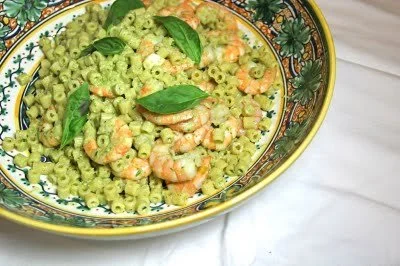
Pasta With Shrimp and Sicilian Pesto


I've been reading
Faith Willinger's newest book, "Adventures of an Italian Food Lover."  It's quite a fun read.  She takes you all over Italy and profiles lots of her friends and includes "254 recipes from my very best friends."  And she's not kidding.  She knows everyone.  For those of you not familiar with Faith Willinger, she is quite famous in the Italian foodie world.  She is an American who has been living in Florence for 25 years.  She's written a number of cookbooks and she travels and speaks and gives cooking lessons out of her home in Florence.  She does "market to table" lessons where she takes the class to the produce stands and selects what's fresh that day and everyone goes back to her home to cook.  I just had to try this pasta from Osteria Antica Marina in Sicily.  It's a light, delicate dish.


Pasta with Shrimp and Sicilian Pesto

serves 6
1 pound large shrimp, with shells
4-6 cherry tomatoes
salt
2 Tbls. chopped almonds
2 Tbls. pine nuts
1 tsp. chopped fresh mint
2 Tbls. chopped fresh basil
1 garlic clove 
14-16 ounces short pasta.

Peel and clean the shrimp.  Combine the shrimp shells, tomatoes, and 2 cups water in a large saucepan.  
Simmer for 30 minutes, then strain the mixture and reduce the broth over high heat to obtain 3/4 cup stock. Adjust for salt.

Combine the almonds, pine nuts, mint, basil, garlic, and 1/4 cup of the stock in a blender or puree with an immersion mixer.

Bring a pot with 6 quarts of water to a boil. Add 2 to 3 tablespoons of salt and the pasta. Cook the pasta until if offers considerable resistance to the tooth, around three-quarters of the package recommended cooking time. Drain the pasta, reserving 1 cup of the pasta water.

Transfer the pasta to a large skillet or a 3 or 4 quart pot. Add the pesto, 1/2 cup stock and the shrimp. Cook over high heat, stirring gently and frequently, until the past is cooked through and the shrimp are hot. Add the pasta water, 1/4 cup at a time, if the sauce seems dry.  Add salt to your taste.

Tip:  Yes, they are serious when they tell you to add 2 to 3 tablespoons of salt to the pasta water.  In Italy, they believe the pasta should be cooked in very salty water, to flavor the pasta, and it should have the "taste of the sea".  


Tip:  When simmering the shrimp shells to make the stock, simmer very gently and if you are losing too much liquid, put a lid on the pot.

Pasta used: Rummo Lenta Lavorazione Tubetti Mezzani Rigati